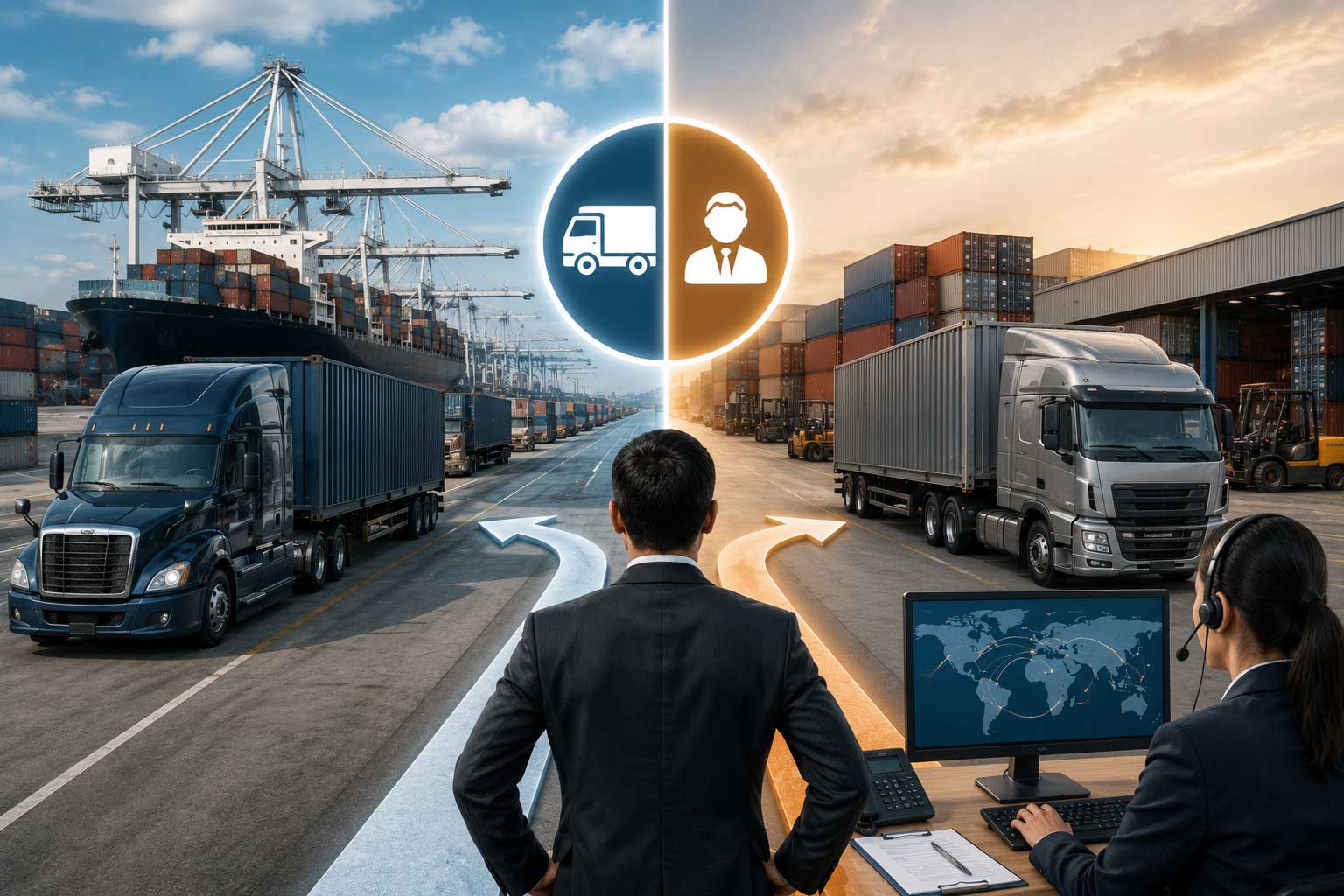
When moving containerized freight between ports, rail ramps, and inland warehouses, securing reliable drayage is often the most critical leg of your supply chain. Despite accounting for a relatively short distance compared to long-haul transit, drayage carries disproportionate risk: port congestion, tight terminal free time windows, chassis shortages, and demurrage fees can quickly turn a routine shipment into an expensive headache.
To execute this crucial first- or last-mile move, shippers generally choose between two primary operational models: partnering directly with an asset-based drayage carrier or leveraging a freight broker (3PL).
Neither model is universally superior – the right choice depends on your volume consistency, lane density, and internal bandwidth. Here is a breakdown of how both stack up and how to decide which option fits your lanes.
Understanding the Models
1. Direct Asset-Based Carriers
An asset-based drayage carrier owns or leases its own fleet of trucks, chassis, and generator sets (gensets), directly employing or contracting the drivers who execute the moves.
- The Setup: You contract directly with the company operating the power units.
- Core Strength: Direct control, equipment guarantee, and operational accountability.
2. Freight Brokers (3PLs)
A freight broker acts as a non-asset intermediary between you and an underlying network of vetted drayage carriers.
- The Setup: You tender the load to the broker, who then sources and manages an asset carrier from their network to execute the run.
- Core Strength: Network flexibility, rapid scalability, and single-source capacity.
Head-to-Head Comparison
| Operational Area | Direct Asset Carrier | Freight Broker / 3PL |
| Capacity & Scalability | Limited to their local fleet size and driver availability. | High flexibility; can tap into vast carrier networks across multiple ports. |
| Price Consistency | More predictable contracted rates on steady, high-volume lanes. | Can offer competitive spot rates, but subject to market volatility. |
| Control & Communication | Direct line to dispatchers and drivers; faster resolution of gate issues. | Communication goes through a middleman, which can introduce lag during emergencies. |
| Geographic Coverage | Strong local/regional focus around specific ports or rail hubs. | Nationwide or multi-port coverage managed through a single portal. |
| Equipment Access | Direct access to owned chassis, reefer gensets, and specialized gear. | Dependent on the sub-contracted carrier’s equipment availability. |
When to Choose a Direct Asset Carrier
Partnering directly with an asset-based carrier makes the most sense when your supply chain demands high consistency, tight communication, and dedicated equipment:
- High-Volume, Consistent Lanes: If you consistently move dozens of containers a week through the same port or rail terminal, an asset carrier can dedicate drivers, chassis, and power units specifically to your account.
- Specialized Freight (Reefer, Hazmat, Overweight): High-risk cargo requires specialized gear—like active gensets for refrigerated goods or tri-axle chassis for heavy containers. Asset carriers directly manage and maintain this equipment, ensuring compliance and reliability.
- Severe Port Congestion Regions: When terminals face heavy congestion, having a direct line to dispatchers who know local gate conditions and driver hours-of-service in real time is invaluable for avoiding costly demurrage charges.
When to Choose a Freight Broker
Leveraging a freight broker is often the ideal strategy when your logistics footprint requires flexibility, multi-region reach, or reduced administrative overhead:
- Irregular or Seasonal Volume: If your container imports spike dramatically during peak seasons or fluctuate unpredictably throughout the year, brokers can easily absorb volume surges by tapping into multiple carrier pools.
- Multi-Port Footprint: If you import across coasts (e.g., Los Angeles/Long Beach, Savannah, and New York/New Jersey), managing separate direct carrier relationships at every port can drain internal resources. A national broker gives you a single point of contact.
- Emergency or Spot-Market Coverage: When your primary carrier runs out of capacity or rejects a tender, a broker’s network provides an immediate safety net to get containers out of the terminal before storage fees accrue.
The Hybrid Approach: Best of Both Worlds
For many mid-to-large shippers, the optimal strategy isn’t choosing one over the other—it’s combining them into a hybrid procurement strategy:
- Core Lanes (80% of volume): Award high-density, predictable lanes directly to asset-based carriers to lock in service guarantees, preferred equipment access, and stable contractual pricing.
- Surge & Outlier Lanes (20% of volume): Partner with vetted freight brokers to manage seasonal surges, secondary ports, and spot-market overflow.
Key Questions to Ask Before Signing
Before tendering your next container, ask prospective partners these qualifying questions:
- For Direct Carriers: “Do you own your chassis pool, and what is your driver-to-load ratio during peak season?”
- For Freight Brokers: “How do you vet your underlying drayage carriers for interchange agreements (UIIA compliance), insurance, and port access credentials?”
- For Both: “How do you monitor real-time terminal dwell time, and what is your protocol for handling gate delays?”
Final Thoughts
Your drayage strategy shouldn’t be an afterthought. By matching high-consistency, specialized lanes to direct asset carriers and leveraging freight brokers for network agility and surge capacity, you can build a resilient drayage strategy that minimizes port delays and keeps your freight moving smoothly.